
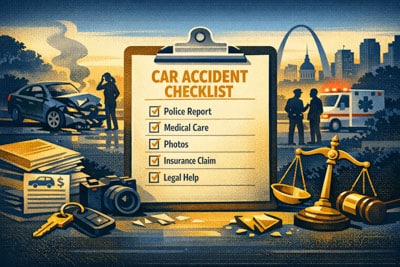
You can speak with experienced attorneys who have secured over $5 billion in negotiated settlements for injured clients by calling 314-963-9000 for a free consultation with no fees unless we win your case. The moments after a car accident can be overwhelming. This comprehensive guide walks you through exactly what to do after a car accident in St. Louis, including Missouri-specific requirements and common mistakes that could hurt your claim.
Whether you need legal representation or not, following these steps protects your rights and health because every action you take in the first hours and days matters. Missouri law requires specific actions at the accident scene, and missing critical deadlines could bar your recovery entirely.
Why These Steps Matter
The evidence you gather in the first hours and days after an accident can be impossible to recreate later. Your actions at the scene determine whether you’ll have the documentation needed to support an insurance claim or legal case. Every moment counts, and proper procedures protect both your physical safety and your legal rights.
Missouri Legal Requirements
Missouri law is specific about your duties at an accident scene. State law requires you to stop at any crash, provide required information, and in some cases, file formal reports. Understanding these legal obligations means the difference between protecting your rights and facing criminal charges. This guide provides the step-by-step framework you need, with local St. Louis procedures that go beyond generic advice.
Immediate Actions at the Accident Scene (First 5-10 Minutes)
Understanding what to do in those first critical minutes can mean the difference between protecting your rights and facing criminal charges. Missouri law is specific about your duties at an accident scene, and these requirements begin the moment impact occurs.
Stop Your Vehicle and Ensure Safety
Missouri law requires you to stop at any crash causing injury, death, or property damage (RSMo § 577.060), and leaving the scene is a crime with penalties that escalate based on the severity of harm. Turn on your hazard lights immediately to alert other drivers. If your vehicle is drivable, move it to the shoulder or nearest parking lot because Missouri law specifically requires moving to the nearest exit on interstates when possible. If your vehicle won’t move, stay inside with your seatbelt fastened unless you see fire or smoke since the risk of secondary accidents in St. Louis traffic is significant—protect yourself first. Never leave the scene, even to “get help” or “call from home,” as the consequences of leaving far outweigh any perceived convenience.
Check for Injuries and Call 911
Adrenaline masks pain, so assess yourself carefully before moving and check each passenger specifically about pain or discomfort. If it’s safe, approach the other vehicle and ask about injuries, but don’t move anyone who appears hurt unless there’s immediate danger like fire. Call 911 for any injury, no matter how minor it seems. Tell the dispatcher your exact location using cross-streets or landmarks in St. Louis since GPS can be inaccurate, and provide the number of vehicles involved, whether anyone is injured, and any hazards like leaking fluids or blocked traffic lanes. Stay on the line until the dispatcher says you can hang up. Even “minor” injuries like neck stiffness could indicate serious conditions like whiplash that worsen over time, so let EMTs make medical decisions—your job is to report what happened.
Secure the Scene and Never Leave
Beyond your hazard lights, take additional steps to prevent secondary accidents. If you have warning triangles or flares, place them 50-100 feet behind your vehicle, and use your phone’s flashlight to increase visibility if it’s dark or weather conditions are poor. Stay out of traffic lanes because many serious injuries in St. Louis occur when people stand behind their vehicles or in the roadway after the initial crash. Stand on the shoulder or sidewalk, away from traffic flow. Under Missouri law (RSMo § 577.060), leaving an accident scene before fulfilling your legal duties constitutes a hit-and-run, with penalties ranging from misdemeanor to felony charges depending on whether the accident caused property damage, injury, or death. You must remain until police arrive and complete their report, or until you’ve exchanged required information with all parties involved. The only exception is if you need emergency medical transport—in that case, inform the police or EMTs before leaving.
Documenting the Accident (Next 10-20 Minutes)
Proper documentation in these crucial minutes after the accident creates the foundation for any insurance claim or legal case. The evidence you gather now may be impossible to recreate later, making this step essential for protecting your rights.
Exchange Information with Other Drivers
Missouri law requires exchanging specific information: name, address, vehicle registration number, and driver’s license information (RSMo § 577.060). Take photos of these documents rather than writing everything down because it’s faster and more accurate, and also collect insurance company names and policy numbers from all drivers. Get contact information for all passengers in every vehicle. If another driver refuses to provide information, note their license plate immediately and inform police when they arrive. Stay polite but brief in your interactions, sticking to exchanging information only. Never admit fault, apologize, or speculate about what caused the accident because even saying “I’m sorry” can be used against you later. Don’t sign anything except official police documents.
Take Comprehensive Photos and Videos
Document everything while the scene is fresh by photographing all vehicle damage from multiple angles, including close-ups of impact points and wide shots showing vehicle positions. Capture all license plates clearly and document street signs, traffic signals, and road conditions including skid marks, debris, potholes, or weather-related hazards. Take photos of your injuries and those of your passengers with their permission, and include the surrounding area, noting nearby businesses that may have security cameras. If safe, photograph inside the vehicles to show deployed airbags or dashboard readings. Most phones automatically time-stamp photos, so verify this feature is enabled. Consider taking a video walkthrough while narrating what you see, but never delete any photos or videos, even if they seem blurry or irrelevant.
Identify and Interview Witnesses
Anyone who saw the accident happen—not just the aftermath—is a valuable witness. Ask directly: “Did you see what happened?” and collect their name, phone number, and email address. If they’re willing, use your phone to record their statement about what they observed. Write down their description in their own words, not your interpretation, and check with nearby businesses for employees or security guards who might have witnessed the crash. Multiple witness accounts strengthen your claim significantly, but never coach witnesses or suggest what they might have seen—let them describe the accident in their own words.
Note Environmental and Contextual Details
Record the exact time of the accident, weather conditions like rain, fog, or sun glare, road conditions such as wet, icy, or construction zones, and traffic density. Note any nearby traffic cameras, business security cameras, or residential doorbell cameras that might have captured the accident. Write down everything you remember about the moments before impact while it’s fresh in your memory because these details often prove crucial later.
Dealing with Police and Official Reports
Police reports provide official documentation that insurance companies and courts rely on heavily. Understanding how to interact with officers and obtain these reports ensures you have the evidence needed to support your claim.
Wait for Police and Cooperate with Investigation
In St. Louis, police must be notified for any accident in city limits resulting in injury, death, or property damage of $500 or more (RSMo § 300.110), though response times vary by district—remain patient. When officers arrive, they’ll interview drivers, examine the scene, measure skid marks, and check for traffic violations. Answer their questions honestly but stick to observable facts, saying “I was traveling north on Grand” rather than “I think I was going about 35.” Never speculate or admit fault, and get the officer’s name, badge number, and the incident report number before they leave.
Obtain the Police Report
Police reports in St. Louis typically become available 3-7 days after the accident, and you can obtain yours from the St. Louis Metropolitan Police Department Records Division at 1915 Olive St., 1st Floor. The current fee is $6.50, and they accept cash or money order only—no personal checks or credit cards. The report contains the officer’s narrative, accident diagram, witness statements, and any citations issued. Review it carefully for errors and report any inaccuracies immediately, then provide copies to your insurance company and attorney.
When You Must File Your Own Report
Missouri law requires filing a report with the Department of Revenue within 30 days if police didn’t respond AND the accident caused injury, death, or property damage exceeding $500 to any person (RSMo § 303.040). Use Missouri Accident Report Form 1140, available on the Missouri DOR website. Even if you weren’t at fault, you must file if these conditions are met because failure to file can result in license suspension.
Medical Attention and Health Documentation
Seeking prompt medical care protects both your health and your legal rights. Insurance companies routinely use delays in treatment to argue that injuries aren’t serious, making immediate evaluation crucial even when you feel fine.
Seek Immediate Medical Evaluation
Adrenaline and shock mask injuries, and many serious conditions don’t show symptoms immediately. According to medical professionals, common delayed injuries include whiplash, concussions, internal bleeding, and soft tissue damage that can take hours or even days to manifest fully. Go to the emergency room for any head injury, chest pain, severe pain, visible injuries, or if you lost consciousness even briefly. Urgent care is appropriate for minor pain when you want evaluation but don’t have obvious serious injuries. Tell medical staff you were in a car accident because this ensures proper documentation in your medical records. Follow all medical recommendations including tests, imaging, and follow-up appointments since insurance companies use any delay in treatment to argue your injuries aren’t serious. Don’t give them that ammunition.
Document Your Injuries and Symptoms
Take daily photos of visible injuries because bruising and swelling develop over time. Keep a detailed symptom journal noting pain levels on a 1-10 scale, physical limitations, and how injuries affect daily activities like work, household tasks, and hobbies. Document sleep disruption and emotional impacts like anxiety or fear of driving. Bring this journal to medical appointments to ensure doctors have complete information because your documentation proves the true impact of your injuries when insurance companies claim they’re minor.
Follow Through with All Medical Treatment
Attend every medical appointment because gaps in treatment give insurance companies reason to deny claims. Follow all doctor’s orders including physical therapy, medications, and activity restrictions, and if your primary doctor recommends seeing a specialist, make that appointment promptly. Keep all medical records, bills, prescriptions, and test results organized, and don’t stop treatment early, even if you’re feeling better. Let your doctor determine when you’ve reached maximum medical improvement.
Insurance Notification and Communication
Dealing with insurance companies requires careful navigation to protect your rights. While you have duties to your own insurer, you must also be cautious about what you say and when you say it.
Notify Your Insurance Company Promptly
Most policies require “prompt” notification—typically within 24 hours. Call your insurer’s claims department using the number on your insurance card to report basic facts: date, time, location, and the other driver’s information. Missouri requires all drivers to carry minimum liability insurance of $25,000 per person, $50,000 per accident for bodily injury, and $25,000 for property damage (25/50/25). Don’t admit fault, speculate about injuries, or give a detailed recorded statement yet. Get your claim number and ask about rental car coverage if your policy includes it. Remember that even if the other driver was at fault, your coverage for medical payments and uninsured/underinsured motorist protection may apply. Never lie or exaggerate to your insurance company because this can void your coverage entirely.
Be Cautious with Recorded Statements
Your insurance company may request a recorded statement, and the other driver’s insurer will definitely call requesting one. Before giving any recorded statement, consider consulting with an attorney—even just for guidance. Insurance adjusters are trained to ask questions that can hurt your claim, using common traps like: “How fast were you going?” “Are you sure you’re injured?” or “You feel fine now, right?” You can respond: “I need to review the accident details before giving a recorded statement.” You are NOT required to give a recorded statement to the other driver’s insurance company, and never give a statement while on pain medication or before seeing a doctor.
Understand Your Coverage and Rights
Review your policy to understand your coverage limits and deductibles. Uninsured motorist (UM) coverage protects you if the other driver has no insurance, while underinsured motorist (UIM) coverage applies when the other driver’s insurance isn’t enough to cover your damages. Medical payments coverage pays your medical bills regardless of fault, and collision coverage handles your vehicle damage. Under Missouri law, insurance companies must handle your claim in good faith—deliberate delays or unfair denials may constitute bad faith.
Protecting Your Legal Rights
Taking the right steps now to preserve evidence and understand your options can make the difference between fair compensation and being left with unpaid bills.
Preserve All Evidence and Documentation
Keep everything related to your accident, including damaged clothing, broken glasses, and vehicle parts. Organize all documents: police reports, medical records, bills, prescriptions, repair estimates, and receipts for accident-related expenses like rental cars, rideshares, medications, and medical equipment. Save all correspondence from insurance companies and create digital backups of photos and videos in cloud storage and on an external drive. Evidence can disappear quickly, so preserve it now, and don’t repair your vehicle until the insurance company has inspected it.
Consult with a Car Accident Attorney
Consider consulting an attorney as soon as possible, especially if you have injuries, the other driver disputes fault, the insurance company denies your claim or offers a lowball settlement, or you’re unsure about your rights. Most car accident attorneys offer free consultations to evaluate your case and work on contingency fees, meaning you pay nothing upfront and only pay if you win. Early consultation helps preserve evidence, avoid missing critical deadlines like Missouri’s 5-year statute of limitations for personal injury (RSMo § 516.120(4)), and prevent costly mistakes. OnderLaw has over 25 years of experience and has recovered more than $5 billion in negotiated settlements for clients. We’re available 24/7 to help, so don’t wait until after the insurance company denies your claim to seek legal help.
Common Mistakes to Avoid After a Car Accident
Understanding what not to do is just as important as knowing the right steps to take. These common mistakes can seriously damage your claim or even result in criminal charges.
Mistakes That Can Hurt Your Claim:
- Admitting Fault or Apologizing: Even saying “I’m sorry” can be used against you because Missouri follows pure comparative fault (RSMo § 537.765), meaning your compensation is reduced by your percentage of fault. If you’re found 30% at fault for a $100,000 claim, you’d receive $70,000.
- Leaving the Scene Too Soon: Leaving before police arrive or before exchanging information can result in hit-and-run charges, even if the other driver says it’s okay because they may change their mind later.
- Not Seeking Medical Attention: Delaying medical care gives insurance companies ammunition to deny your claim since they’ll argue that if you were really hurt, you would have sought immediate treatment.
- Accepting Quick Settlement Offers: First settlement offers are typically far below your claim’s true value because insurance companies hope you’ll accept before knowing the full extent of your injuries. Settlements are final—you can’t reopen them if injuries worsen.
- Posting on Social Media: Insurance companies monitor social media for posts and photos that contradict your injury claims. Don’t post about the accident, your injuries, or your activities until your case resolves.
Frequently Asked Questions About Car Accidents in St. Louis
What do I do immediately after a car accident in St. Louis?
Stop your vehicle, turn on hazard lights, check for injuries, and call 911 if anyone is hurt. Exchange information with other drivers, take photos of the scene, and wait for police to arrive. Do not leave the scene or admit fault because these immediate steps protect both your safety and your legal rights under Missouri law.
Do I need to call the police for a minor car accident in St. Louis?
Missouri law requires a police report if there are injuries, property damage exceeding $500, or if a driver is uninsured (RSMo § 300.110). Even for minor accidents, calling police creates an official record that protects your rights and helps with insurance claims. When in doubt, it’s better to have an official report than to wish you had one later.
What information should I collect from the other driver?
Collect the other driver’s name, address, phone number, driver’s license number, license plate number, insurance company name, and policy number. Also get contact information for any passengers and witnesses, and take photos of their documents rather than writing everything down. If they refuse to provide information, note their license plate and inform police immediately.
Should I go to the hospital after a car accident even if I feel fine?
Yes, you should seek medical evaluation within 24 hours even if you feel fine because adrenaline and shock mask pain, and many serious injuries like whiplash, concussions, and internal bleeding don’t show symptoms immediately. Delaying medical care also gives insurance companies reason to deny your claim, so let medical professionals determine if you’re truly uninjured.
What should I do if the other driver doesn’t have insurance?
Still follow all accident steps—get their information, take photos, and file a police report. Your uninsured motorist coverage will cover your damages, so contact your insurance company immediately and consult with an attorney to ensure you receive full compensation. Missouri requires uninsured motorist coverage unless you’ve rejected it in writing.
How long do I have to report a car accident to my insurance company?
Most insurance policies require “prompt” notification, typically within 24-72 hours, and delaying notification can result in claim denial. Call your insurance company’s claims department as soon as possible after the accident, even if you’re not sure you’ll file a claim, and provide basic facts but avoid giving recorded statements until you’ve consulted an attorney.
Can I leave the scene if the other driver says they won’t file a claim?
No. Missouri law requires you to remain at the scene until police arrive or you’ve exchanged information with all parties (RSMo § 577.060). Leaving the scene is a crime even if the other driver says it’s okay because they may change their mind later, and you’ll face criminal charges. Only leave if you need emergency medical transport.
What if I’m partially at fault for the accident?
Missouri follows pure comparative fault (RSMo § 537.765), meaning you can still recover damages even if you’re partially at fault, though your compensation will be reduced by your percentage of fault. For example, if you’re 30% at fault for a $100,000 claim, you’d receive $70,000. Never admit fault at the scene—let investigation determine liability.
Should I accept the insurance company’s first settlement offer?
No. First offers are typically far below your claim’s true value because insurance companies hope you’ll accept quickly before you know the full extent of your injuries or consult an attorney. Wait until you reach maximum medical improvement and consult with an attorney before accepting any settlement since settlements are final—you can’t reopen them later.
What should I do if the other driver fled the scene?
Call 911 immediately and provide any information about the vehicle including make, model, color, license plate, and direction of travel. Look for witnesses and nearby security cameras, file a police report, and contact your insurance company about uninsured motorist coverage, which may cover hit-and-run accidents. Cooperate fully with the police investigation.
Get Legal Help After Your St. Louis Car Accident
Now that you know what steps to take after your accident, understand that you don’t have to navigate this complex process alone. Following these steps protects your rights, but when injuries are involved, when fault is disputed, when insurance companies deny or lowball your claim, or when you’re facing mounting medical bills and lost wages, you need experienced legal representation. OnderLaw provides free consultations with no upfront costs—you pay nothing unless we win your case. With over 25 years of experience and more than $5 billion recovered in negotiated settlements for our clients, we have the resources and expertise to handle even the most complex car accident cases.
✓ No Fee Unless We Win
✓ Available 24/7
✓ $5B+ Recovered